Sunday, August 9, 2015

A Gun a Week: Remington Model 760 Gamemaster, .35 Remington

Remington Model 760 gamemaster, .35 remington.


If you ever been to a pawn shop, and a rifle catches your eye, you know that horrible feeling you get when the guy behind the counter flips the tag for you (you always have to ask--no gun store is smart enough to display hang tags with the prices facing out) and you see how much they think their rifle is worth. You know and I know and the guy behind the counter knows that the shop has paid someone around fifty cents on the dollar for that rifle, so why do they always ask for exorbitant amounts on rifles that they've pretty much stolen from someone who needed quick cash? I'm not real sure, greed I reckon.

Anyway, such was the case back in 2006 when I spied this Remington Model 760 Gamemaster on the rack among all the Mossberg pump shotguns. I think at the time they wanted $399.99 dollars for it...as if anyone'd be fooled by the missing penny. I recoiled in horror and amusement. The 760 was obviously old as dirt and was missing its magazine which meant right away, if someone bought it, he or she'd be on an epic quest to find a vintage magazine to fit it.

These rifles were made on the same frame as Remington's 28 gauge Wingmaster shotgun, so the feel of the stock and the weight and the position of the safety and trigger were very familiar to me. There wasn't much bright bluing left on that receiver, but there wasn't much more than faint surface rust either and just a few scratches. The old original sights were still intact, though I knew I'd scope the thing--as old as it was, it was drilled and tapped for a scope mount for sure.

Same frame as a 28 gauge Wingmaster so all the controls are very similar.

I asked to fondle it which means I was really interested to see it. These days I'm at a point in my life where I don't need to fondle guns to shop for them. I mean, you fondle one Model 700 or Model 70 or Glock pistol, you've fondled them all. No, just tell me how much you want for it. But at the time, I wanted a closer look for sure. I wanted to see what chambering it was, and seeing that it was chambered in 35 Remington made me really want it. 

You see these pumps, the "Yankee Lever guns" all the time in plain-Jane, boring old 30-06. And you see those rifles all the time for sale around the $350.00 mark. So dull in fact that a guntard like me wouldn't even want one of the old ones in 30-06. No, all the cool ones are in old-school numbers like 300 Savage, 257 Roberts, 244 Remington and, naturally, 35 Remington. I've seen one since I bought mine in 270 Winchester, which is also pretty neat, again, giving that it isn't in that ol' has-been 30 caliber. 

Old timers trick to reverse the rear sight for scope mounting...that way you you'll not lose it.


So I made an offer of $250.00 and was laughed at by The Man...that was 2006.

It's a pawnshop in Kernersville, NC and I used to stop by every quarter or so to check things out. I lived in Stokesdale, NC and it was on the way to Target, Walmart and BoJangles--pretty much everything you need to survive, so it was as easy as pie to stop in and see what else they had. Once I stopped in, and the normal guy behind the counter was gone, replaced by another guy. I asked him about the rifle again, and he handed it to me unprompted. By now they had stuck a magazine, or tried to, from a different model Remington, a 742 Woodsmaster! It was literally jammed in and since it was designed for a semi-automatic version of this same rifle more or less, it didn't allow the function of the slide at all.

I told the guy it wasn't the correct magazine and looked at the price tag. It was holding fast at $399.99 so I made an offer of $250.00 to the "new guy" and was laughed at...that was 2007. In fact, I think I did walk out of there with a Model 700 in .243 Winchester which, by some crazy misalignment of the universe was being offered at a reasonable price!

The model 760 was introduced in 1952 and ran until 1981. Only about 1.03 million were made! I knew this gun was an early one by the rather plain forearm and hard metal butt plate. I think they call it a corncob fore end because it sports simple cuts to allow a good pumping grip and it resembles a cob of some kind. I had shot a former customer's (in 300 Savage--very high cool factor) and his was around the same age and so they were very similar in appearance and wear. And since I had coveted his granddad's rifle then, it only made me want the pawn shop's even more.

Corncob fore arm says "old school".


I stopped in again several months later and asked about the rifle. The "new guy" was still there and so was the rifle. Only now the pump-o-matic had lost the mismatched magazine for the empty hole again. If anything, this was actually better. Imagine buying it and getting to the range and finding out it wouldn't work; caveat emptor I reckon.

I don't remember the price at that time, but I offered him $250.00 and was laughed at by him and the owner....that was 2008. I did find a nice Western Auto version of a Marlin 336 in 30-30 Winchester which, because it didn't say Marlin on the barrel, was offered for a very reasonable price--$250.00 as I recall.

As you know, 2008 brought a grinding halt to everything alot* of us knew about building houses and making money. It was like waking up with amnesia--overnight everything had changed and I had to learn many hard lessons. The one lesson I always repeat is, "I'll never take money or work for granted again."

Aluminum (I think) butt plate. In 30-06, that'd be brutal on your shoulder.

I bet I didn't step foot in that pawnshop for two years; why would I? I didn't have any money to spend. I'd drive by and think about it but never got out of the truck. But when things started looking a little better, I thought about stepping in again. And when I did, there was the little rifle waiting for me. I flipped the tag to check the price: $299.99! They were getting closer!

I smiled and made my offer to the owner himself--I guess they had to get rid of some people on account of the depression. I offered $250.00 and was laughed at by the owner....that was 2011.

In the meantime, I had dropped deer with the .243 I bought there. I had dropped deer and even taken my buddy Bill on his first deer hunt with the Western Auto 30-30 I bought there. So when Christmas was coming up the next year, I knew I had to get myself something to ease the pain of buying everyone else I know and love something they wanted.

And when I walked in the pawnshop that last time, I explained myself to the plucky "new kid" behind the counter. I knew that the gun had been there for six years and told him. I knew a new magazine for it was going to be a fifty dollar ordeal and I told him. I laid it all out for him, and he took my case to the owner. When the owner looked at the back of the tag and saw it was a six-year-old pawn, I knew I had him. I offered him $250.00 and he took it...that was 2012!

Sure they got me for tax, of course they did, but in principle, I got that fricking rifle for $250.00! And it only took six years. As soon as I got it home and got a Leupold 4x M8 scope on it, there was a photo-op in the bathroom--nothing pervy, that room just had the best bank of bulbs in the house.

Facebook photo op shortly after i bought it. Note missing magazine.


That weekend it was taken to the range to get zeroed in. Around this same time, I had some of Hornady's Leverevolution ammo left over from previous hunts with a Marlin 336CS in the same chambering, so it was a no brainer to use it. Obviously, the 760 is vertically fed from its magazine (which I was missing when I zeroed it--think, single shot rifle) so I didn't have to shoot ammo designed for a tubular magazine fed rifle like the Marlin, and some day I might just whip some ammunition up from the bench with good old fashioned spitzer bullets, but I did for that hunting season. That ammo is really good stuff for any rifle in 35 Remington. They also make it for 30-30's as well, and I can't say enough good things about those two offerings.

The next weekend, after buying a modern magazine for the 760's progeny, the 7600, the rifle and I were in a tree stand. The newer magazine was very difficult to install and extract, but it would have to do for the first hunt. The cartridges fed flawlessly from the magazine even though it was a true pain in the fingers to get the thing in or out of the receiver. Sadly, I have three modern mags for the rifle which I probably never use again. Later I found a dusty old vendor at a gun show and he had a dusty old magazine that fit my rifle perfectly for, you guessed it, fifty dollars...turns out my gun was $299.99, but I digress.

And when the gang of does stepped out of the thick woods to graze and cross the logging road I was perched above on the farm in Eden, I picked the biggest one, the one staring intently and knowingly at me, and took her down instantly and humanely with a neck shot. She was inside 100 yards, but further than fifty away which is the perfect range for any rifle chambered in 35 Remington. When I walked up to her I took a picture of her with the rifle not to gloat, but to document what she looked like before I killed her, to document when and where I was and with which rifle I had killed her. I think it's important to remember you killed something, to "make a mark" that you'll always have, and thanks to the internet, I will.

The evening light makes phone photography tough.
It was good to get the old gun into the woods again.

I did in fact take a copy of that picture back to the pawn shop to show the guys what I had done with "their" rifle. I wanted them to know I wasn't some crackpot guntard that wanted the rifle for a low-ball price just to tuck it away in a vault forever. I wanted them to know I took an old hunter hunting again. A quick Google search had told me my gun was made in 1954, and I was happy I got it off the rack and back out into the woods to do what it was designed for.


Nature-made tree stand.


I hunted with it again the next year down on federal game lands--I could tell you where, but then I'd have to kill you--and watched a dopey young six-pointer mosey right by me from the top of a busted down tree. It was a natural deer stand, and from atop it, I watched that buck the whole time he was in 35 Remington range through the scope as he ambled by but never shot him. Maybe I was just enjoying sitting in the woods watching the first big, black squirrels I had ever seen in the wild dig around in the leaves, or maybe it was that old realization that the fun's over as soon as the smoke clears, and the truck was parked a long long way away to drag a deer.


Scope caps up, this dog will hunt.


Sunday, August 2, 2015

A Gun a Week: Remington Model Seven, 7mm-08 Remington


Remington Model Seven, 7mm-08 Remington


Quickly after becoming a guntard, or rather, an enthusiast, you quickly get sucked into a certain school of thought after you realize that you can't hunt or shoot with just any over-the-counter, store-bought rifle. And I bought into this for a while, for sure.

First is the realization that you can't kill deer with any of the common cartridges sold in Walmarts all over America. No, a 30-06, .243, 30-30, or a .308 just won't do anymore. You need a custom-chambered rifle for your hunting needs in some ancient cartridge that preceded them all. You need a rifle chambered in a cartridge like 7x57mm Mauser that was developed in 1890-something to beat out all the other guys with their cookie-cutter rifles at the hunting-shooting game. 

Here's Emily in 2006 behind the scenes at The Gunsmith's with another "custom" rifle...
I guess we were trying to goad him to finish it by pestering him.

To do this though, first you need to buy an old beater rifle...that's at least 400 bucks. Then you need to buy a new barrel for the thing, and that's another 400 bucks. Then you need to pay a guy to put the two together...that's another 300 bucks...you see what I'm getting at? If you read anything I've written about a "custom" rifle I own, this is what I had to do. It's an expensive process, but slow, so the costs get spread out. But it's something I've done to the tune of a bunch of dollars. Sigh. 

And so it was, several years ago when I wanted a rifle chambered in that old, grandfatherly cartridge, 7x57mm Mauser, in stainless steel so I wouldn't have to wait a year for the gunsmith to get around to bluing it, that I had the mother of all epiphanies: what if I just bought one ready to go? 

Another realization you come to as a guntard is that your nine-pound rifle is way too heavy to tote all the way from your truck to the deerstand. Think of all the other stuff you have to carry: your binoculars, cell phone, and...well, that's about it, but that's alot* when you're bundled up in winter wear. No, you need a svelte little carbine that comes in under seven pounds of course. And they make and sell those for sure. Kimber Mfg. makes them and sells them at such a premium, think MFSR $1,768.00 (from the pages of this month's Rifleman), that gun-nerds will hand it right over to keep from straining their backs. I can't do it, well, not all at once; I got kids...and dogs. 

This is why I type out Model Seven every time. It's just how it's done!

And that brings us back to the afore-mentioned cookie-cutter rifle. Turns out Remington makes exactly that for less than half of the cost of a Kimber. The Model Seven. The only compromise I had to make was getting one in a modern cartridge. You see, the old 7x57mm Mauser cartridge won't fit in a modern short action, but the ballistically identical 7mm-08 Remington will. Introduced in 1980, it's a pretty old design...not as cool and as old as the Mauser round, but it'll do.

The real selling point on the cartridge is this little rifle. Its action is a quarter inch shorter than a regular old Remington model 700 and I guess that little bit helps it shed some weight, and they come with a shorter, thinner barrel too, which also helps keep the weight down. The one I bought, brand new (the last rifle I ever bought brand new eight years ago or so) also has a super-slim plastic stock that makes the thing feel almost toy-like in my grip. If ever a rifle was made for carrying around unnoticed on your shoulder for less than the cost of a used car on Craig's List, this is it.

The barrel is 20 inches long with only about 19 1/4 inches sticking out of the action. It's pencil thin at the end, which you'd think would hurt accuracy but this is not the case! The handload I manufactured for it back in 2007 comes in under an inch at 100 yards and amazingly, at 200 yards as well--shocking to say the least for any rifle let alone a little hunting carbine.

Reloaders save the good, the bad, and the ugly. We need the data so we don't
repeat bad recipes and do replicate the good loads. This is a good load.


Heck, the whole rifle is only 38 3/4 inches long. Mine weighs 8 pounds with the scope, sling and four cartridges in the holder strapped around the stock which means it's a pound lighter than most rifles are nekkid. Admittedly, I didn't do a very scientific weight check by doing the old weigh myself with the gun and then without, but I think it's close enough for the ten people who read this blog...on a side note, I'm back on the Atkins Diet for the next two weeks.

A meter of rifle!


If you look at pictures at an old Remington model XP-100, I think you can see the lineage of the Model Seven. They seem to sport the same action so if you get rid of the XP-100's weird dog-legged bolt, oddly-shaped safety, and "pistol" stock, and exchange it for the standard Model 700's controls, you've got the Model Seven. It wouldn't be too much of a stretch to convert a Model Seven into a pistol...but why in the world...

Here's an old XP-100. 

Here's the Model Seven's controls...You can see the lineage I think.


The only bad thing I could ever say about my rifle is that the recoil pad went "sticky" like most of the Remingtons sold in those days. It's a Limbsaver Inc.'s problem that became a Remington problem, but it's easily fixed. I just haven't gotten around to it yet. Such a pain to have to unglue it from the safe floor to get it out for hunting or fondling. And I might just take this opportunity to fix it once and for all for the photos.

Sticky pad problems. Look close and the cartridge headstamps are 308 WIN which
is the parent case for the 7mm-08--a run throught a sizing die does the conversion.

The first doe I shot with this rifle was a micro-deer at 125 yards. I had only been hunting for four years or so back then and sometimes had trouble judging deer sizes in waning light and through the 2-7X Leupold so I consider the fawn an "oops" moment--but! the small ones sure are tender and tasty and easy to manage I hafta say. Two more does in December 2011 and November 2013 until the latest doe in December 2013 which was an awful experience in the perils of neck shots.

A hundred yard, more or less, shot to the neck which dropped her in her tracks as usual, apparently didn't kill her right away and after hours and hours of tracking ever-shrinking blood drops, we finally gave up finding her. I had started using neck shots because it usually keeps the deer in sight for quick and clean kills which is what every hunter should want. I know I work pretty dang hard to keep my kills clean and humane as possible, but lousy shots happen for one reason or another. It sucks when you flub a shot and I think about them often, mostly to try to prevent them from happening again, but also as a type of self-flagellation I suppose.


It's important to not let bad shots from seasons past affect your confidence on the next shot opportunity for the worse. I always say killing an animal is an awful and terrific thing--terrible and thrilling all at the same time...and you don't need the spectre of the last dicked-up shot making you place yet another misplaced shot downrange. There's alot* going into the mental game of taking game. 

Anyway, this little rifle is a proven shooter and game-getter as long as I do my part. I can't think of anyway to improve it except to buy an even better scope for it. Trim little rifle need trim little scopes on top. And of course, I need to get around to fixing the sticky pad. Other than that, I wouldn't change a thing. 

An extra pair of eyes never hurt.

Of course, all the while, I still keep an eye out for an old rifle chambered for an old cartridge like, say, 7x57mm Mauser. They're still out there.

Ilion's smallest high-powered rifle. The Model Seven.

Sunday, July 19, 2015

A Gun a Week: Glock 27, .40 Smith & Wesson

The Glock 27, 40 Smith & Wesson (top) on the bathroom counter posing. The Beretta 92FS Centurion is below...
but that's another story.


This is really a confessional, a hat in hand, head held low kind of post that I never thought I have to write. When I started AGAW I chose to write about the firearms I own, and until several weeks ago today, I still owned this pistol. Obviously I didn't have time to take several posed pictures of it since it was taken, so all I have are photos pulled from Instagram and facebook posts.

But first: the pistol was a slam dunk. I saw it at The Gun Rack in Kernersville and joked with the owner that if it were still there on my next payday I'd buy it...and it was. The Glock 27 is the "mini" version of the polymer pistol that literally changed the gun-toting world when it came on the scene in the eighties. It is the plastic gun the media told us would be able to pass through metal detectors undetected (it won't and never could). And in the early days, people loved to gripe about them.

They didn't have an external safety. Well, I always said, so what? Neither do revolvers. And they actually do have a little lever in the trigger that won't let you pull the trigger unless it's pushed in.

Simple, in fact, Glock calls it, "Perfection," and they are close.

They had a plastic frame. Well so what. If you ever carried a full-sized Beretta 92 or 96 around on your hip all day, you'd understand how a dozen ounces less can feel so much better at the end of a day.

They had a boxy grip that just wasn't comfortable, but if you've ever shot one enough, you know that's not even an issue. I never missed a plate or target because the grip was boxy. My gun was bought altered, by the way, and you can tell by the picture, compared to factory Glocks, that the "backstrap" was reduced somehow while the texture was "customized" as well. I'm not sure it helped the pistol at all, but it certainly didn't hurt it. 

See the after-market texture that was added later? The trim backstrap?
Also note, as far as the BATFE is concerned, that's the pistol--the part with a serial number.


But after those early days, everybody wanted one. Law enforcement were the first devotees I'd say, and then the carrying public. And that's when I got mine, in the very late '90's. The 40 Smith & Wesson cartridge was developed in 1990 or so and quickly also became a darling of police forces and private citizens who wanted, as always, more punch in a smaller frame.

The .40 S&W is a powerhouse, high-pressure cartridge that is the shorter and handier fraternal twin of the 10mm Automatic. The 10mm Auto cartridge is long enough to require bigger frame pistols that not everyone can hang onto very well, but, the 40 S&W was shortened enough to fit in Glock's standard-sized frame that started with the Model 17 in 9mm Parabellum. In other words, any frame Glock could fit a 9mm Parabellum cartridge into, they could fit the 40 S&W as well. And offered in three sizes, mine fit at the bottom as a "Mini" or sub-compact model.

One sleepy night I accidentally put the little Glock down on my gum park.

And that small size and light weight means that not only is it a gun you can carry comfortably, but it's also a gun you will carry probably more often than not. I know I sure did. In fact, the stubby pistol was the first pistol I owned that I was actually able to conceal without a noticeable bulge in my waistband. And that meant that if I had my pants on, I was carrying a pistol.

Even playing around with a coal stove, the Glock was always easy to carry.
Does my Glock make me look fat?
I never had to unholster the gun on a person or to "defend" myself, and likely never will. That's just a fact. But I came very close to defending my toddler-sized daughter at The Last Minute Market in Stokesdale several years ago. The owner's two "pitbulls" both at once came shockingly quickly from around the counter right up to my daughter's face--they were all eye-level. It happened so fast that no one had time to think, I just reached down and grabbed her up with one arm and pushed the dogs away with a gentle knee. My right hand was on the Glock's grip, but no other action was required...just some raised eyebrows!

The little pistol has even taken two deer. Both deer, taken several seasons apart, were shot high on the shoulder and weren't dying painlessly, and rather than let them die slowly while suffering, the little Glock was used to dispatch them quickly. The last time I used it on a deer was last year in Vance County on a little buck on federal gamelands during muzzleloader season. 

I have even taken a squirrel with it on a whim headed back to a buddy's house after a morning of duck hunting. Short-barreled handguns can be accurate enough to take a tree rat at 15 or 20 yards in the right hands. Once, I even shot an empty .45 Auto case off a metal cable on a police practice range at 7 yards on a bet with some fellow shooters who happened to be cops too. But for the tree rat, it was a classic broadside.

The acorn wasn't placed there, the squirrel had clamped down on it.

So yeah, the poster boy for "lock your guns up" let his guard down and left a gun in a car over night. And at some point, early in the morning, someone lifted it after going through all our vehicles. I have all the excuses--we were gong to head out later again after seeing the boy and his date off to the prom, but got stuck on the couch--but it just boils down to being lazy. And for that the universe punished me. What's worse is the notion that the pistol could be used for something awful in the future by someone who obviously doesn't care about respecting other people. 

That's what's been so hard to take for me personally. That's why TGAW project was met with a grinding halt the Sunday the pistol was stolen...I haven't had the stomach for writing about my guns when I literally gave one away to a criminal. It's taken this long to "show my face" again. Sure, there's a slim chance I'll get it back--it could happen, but I won't hold my breath.

Naturally, I took to carrying the Beretta again (see photo at the top of blog) and kept my eye open for another Glock and found used one at a good price at Powers Firearms, Inc. in Greensboro I jumped on it. My first Glock back in 1995 was a Glock 21 in 45 Auto, and now, my latest Glock is a 36 in 45 Auto as well. It's a "mini" as well, and I haven't shot it very much, but I've shot it enough to know it will work, even with my handloads.

The little Glock 36, 45 Auto. New to me.

I hope to carry it at least as many years as I did that little 27. I know I'll be more careful and less lazy with it. It will always be near. I'm pretty sure I'll never need it, but I have fire extinguishers too.

Sunday, May 24, 2015

A Gun a Week: Browning Citori XS, 28 gauge

Browning Citori XS, 28 Gauge.

If shooting skeet with an automatic shotgun like a Remington 1100 teaches you anything, it's that unless you bring your wife or your mom with you to the field, you're gonna have to pick your hulls up yourself. Whether you pick them up as you shoot them, which is frowned upon by the rest of the squad, or after you're done with the round, it's a pain in the back. They add up and they get scattered about and mixed up with your buddy's rather quickly. Yeah, it wasn't long before I decided I needed an "over and under" shotgun that lets you shoot your targets and then deposits the empties right into your hand.

The lever that opens the action so you can load or unload the shotgun.

On Citori over/under shotguns, after firing you push the lever on top to the left and the action "breaks" open on a hinge and the empty hulls are shot by spring-loaded ejectors out of the gun--and if you're smart and lazy--right into your hand. Some folks can eject the shells and catch them out of the air with one hand. I cannot. One of the reasons I don't play professional ball (of any kind) is that I can't catch. I just let them pop directly into my hand and then into my Walmart shooting pouch which I've had since 2001 or so. No bending over is involved.

Eject! If you're smart, you cup your hands over the flying hulls so you don't have to
bend over to pick them up. If you're good, you catch them mid-air in one hand! 

After taking a beating from Browning Citori 12 gauge over/unders, and dragging a hefty "tubed" Citori--a gun that lets one shoot sub gauges in his 12 gauge--around the skeet field, I figured I'd be better served if I just had a 28 gauge. Everybody already knows that 28 gauge shotguns are magic. Lithe and slender, they are easy to carry on the skeet field and while hunting though I ain't never hunted with mine and probably never will. It's too fancy!

The Citori line from Browning Arms Company was introduced in the '70s and was a cheaper to make version of the Browning Superposed which was the last firearm design drawn up by the man himself: John M Browning, genius. The Citoris are made in Japan instead of Belgium, like the old Superposeds were, and everyone poo-pooed on them because of that fact early on. I don't have a problem with that. In fact, but Japanese precision machining is right up there with the best, and these days, with CNC machining they're making guns that're tighter than Dick's hat band...which is good.


There's gold in the engraving and the trigger.

Admittedly, I wasn't actively looking or shopping for one when I saw the ad in the catalog from CDNN Investments but as soon as I saw a 28 gauge Citori XS for "BELOW COST!" I had to have it. Normally, the paying for relatively high-dollar shotgun like an XS would be the hard part. But luckily I had an old F-250 laying around that I sold to a former co-worker and with that wad of cash deposited in my checking account, I called CDNN while my debit card was burning my fingers. It was just meant to be. Shipped to the gunstore's FFL holder, my buddy, and I had it a week later.

If you've ever unboxed a new gun that you have bought sight unseen, for more money than you make in a week, you just haven't lived. Waiting for a child to pop out of your wife or significant other at the hospital is a close second to the anticipation you feel unwrapping a shotgun you've never laid eyes on. And, as with my kids by the way, I wasn't disappointed! It was lovely seeing the nicely-figured wood and the bright and shiny bluing that was all brand new. As a dumbass carpenter used to working for a living, brand new guns are few and far between, but this, this Miroku-made Browning XS was brand-spanking new and all mine!

The finest piece of wood on any shotgun I own. The one ding is from a clay
target shard. Yet another reason to wear safety glasses when shooting.

And if that weren't enough, the store where I'd had it shipped was run by my buddy who just so happened to have worked at Browning Service in Missouri as a budding, fresh-out-of-college gunsmith and did in fact, have a barrel set in .410 bore laying around the shop unused. Now, the Japanese company that the purists hate machine these things to tolerances only dreamed of by a bunch of Belgians and thankfully, the .410 barrel set snapped right onto the 28 gauge receiver with no fitting needed! One snap and I had a two barrel set! Two guns for the price of one.

A desperate search online to find a barrel set case was launched at the time.
The case too is a Browning of course.

At the time of all this gun buying and alteration, I was a professional skeet shooter, so this was exactly what I needed. Yeah, needed, to play the game in all four gauges. I never said I was any good at it, but I was a real professional! I wasn't the worst at it, but I wasn't anywhere near the best. Luckily the shooters are classed, like runners are by age, but on their ability. One of the most humiliating defeats was to a guy named Pittard. Pittard! I can't even say the name without spitting a little.

At his home club, after losing in the 28 gauge event to him the year before, I was killing him one summer's day. I was on my fourth box with only two misses, up on him by two targets. We were on station seven...the easiest, most Brett-friendly station from which to shoot skeet of them all. All I had to do was hit the next four at station seven and I was gonna beat Pittard at his own field! Pittard! The six-foot-six giant, braggart and hubris-filled oaf was about to be taken down by little ol' Brett. I had one job...and I choked. I missed two or three of the "low seven" targets and watched my dreams of victory sail away toward the boundary stake and waft into the grass where if finally broke no thanks to me, my stupid brain, and my Citiori XS.

A Buckmark where it belongs: On a Browning and not some hipster's car.

I remember falling to my knees crushed as my Shooting buddy Bill Carter behind me was saying, "Brett," in that head-shaking tone that only southerners can do. It wasn't long after that I gave up my professional skeet shooting status and became the casual shooter I know and love now. I never did test well. I did have a great day with my Citori once at The Rock when I ran a straight, that is 25 targets with no miss, against a dude with a Krieghoff K80 and pretty much whooped his ass. A K80 starting cost is around $10,000 and goes up to the-sky's-the-limit dollars, but I smoked his bacon with a dirty Japanese Citori XS, homemade two-barreled set in .410. It might've been the best day of my life. I shook hands with the guy and left with three more boxes I had intended to shoot still in my car--I know when to quit.

As I mentioned in an earlier post, the 28 gauge is in my mind the perfect gauge to start out new shooters and I've taken more than a few folks out with this shotgun for their first run at the targets. It just makes sense. Sure, about a million people have started out with a .410 shotgun, but that shell only holds a half an ounce of shot. Sure, there's no recoil, but if new shooters keep missing, they may not ever want to come back out and try again. The more shot you throw at a target, the better your chances of hitting it. The 28 gauge flings three quarters of an ounce of shot and pushes back enough to let you know you're shooting a shotgun, but it will never hurt you. It's the Stay-Puff Marsh-Mellow Man of the skeet world.

I sound like a broken record, but when you want to take new shooters on the skeet field,
you can't go wrong with a soft-shooting 28. All smiles and no bruises!

I guess I could hunt pen-raised quail with it, as long as the sun is shining and there are guaranteed no briers underfoot. I hate to say it, but it's too pretty to risk. I got that 1100 in 28 for the hunting jobs. No, when you see me with this shotgun, I'll be dandied up on the skeet field where I can keep an eye on my gun and baby it. And if you want to go, buy you some 28 gauge, Remington STS shells and give me your empties when we're done! That's all I ask in return. Skeet you know takes about a minute to learn and a lifetime to master!

An American designed Browning XS was used at the Camp David skeet/trap field
 by non other than the president of this country. Though a 12 gauge, it's still a
beauty, still a Browning XS! 

Sunday, May 17, 2015

A Gun a Week: Winchester Model 70, 6.5X55mm Swedish Mauser

Winchester Model 70, 6.55X55mm Swedish Mauser


This rifle was my second "custom" rifle project that I had done when my buddy owned a gun
shop and I was a hanger-on. Sometimes, when you need a rifle in a caliber that isn't offered currently by the three major manufacturers, you have to go off chart. Why did I need a rifle in a not-so-popular European cartridge? Well it all started with another rifle that was chambered in an even more not-so-popular cartridge, the 7.5X54mm French MAS that I'd bought years before! See, the French 36 MAS was a rifle (more on it later) whose ammunition was about impossible to come by when I bought it. And usually that's not a problem for a reloader like me. I'd buy the brass, get some powder, dies, and go to pulling on the one arm bandit in the garage until I had a box of ammo. But! there was no brass to be had. So the next best method of stoking an old French gun was cartridge conversion.

Turns out, you can form 7.5X54mm brass out of 6.5X55mm brass. So like any student of reloading, I headed down to the gun store and ordered up a batch. The problem was that the owner didn't ask, and I didn't mention, how many pieces I needed. So 500 pieces of 6.5X55mm brass later I was ready to reform and reload some 7.5X54mm cartridges. And I did that with mixed results. The fired cases were so bulgy and misshapen I was scared to keep doing it, and I put the rifle aside for a while...for years. By the time I got around to wanting to shoot the old French gun again, there was this thing called the Internet out there which made ordering the right brass very easy. A few clicks at Graf & Sons and the days of scary, distended cases were over for the old French gun...

But in an ammo can out in the garage, there were close to 480 pieces of brass for a cartridge that I didn't even own a rifle with which to shoot them. And that's when I started thinking about rebarreling a used rifle and that brings us to a used Winchester Model 70--remember the Model 70 I was blogging about? And sure enough, one came through the gun shop on consignment with the right price on it.  I snapped it up, prob'ly never even shot it, and placed an order with ER Shaw Inc. on their website for a 24 inch sporter barrel with a .264 inch bore. I had broken ranks with my gunsmithing buddy and bought a stainless barrel from ER Shaw instead of from the hallowed halls of Douglas Barrels, Inc. Heresy I tells ya! But I was in a hurry.

Long and lean, skinny for caliber 6.5mm bullets cleave the air and lose velocity
much slower than their 30 caliber counterparts--in other words: Flat Shooting.

The Model 70 I bought was Winchester's economy model. It sports a blind magazine that has no hinged floor-plate for quick unloading meaning you have to run each cartridge through the action one by one to unload the rifle when you're done hunting for the day. You can do this safely because in the middle position the rifle's three position safety, a throwback to our old buddy the 1903 Springfield, allows you to block the trigger and sear connection yet work the bolt to remove your cartridges. Click the safety all the way to the left, and everything is locked up. Click it all the way to the right and KaPow! It's such a neat swing safety that aftermarket suppliers make it so you can fit this type on Mausers, Remingtons, etc.


The very safe safety is set to "KaPow" in this photo.

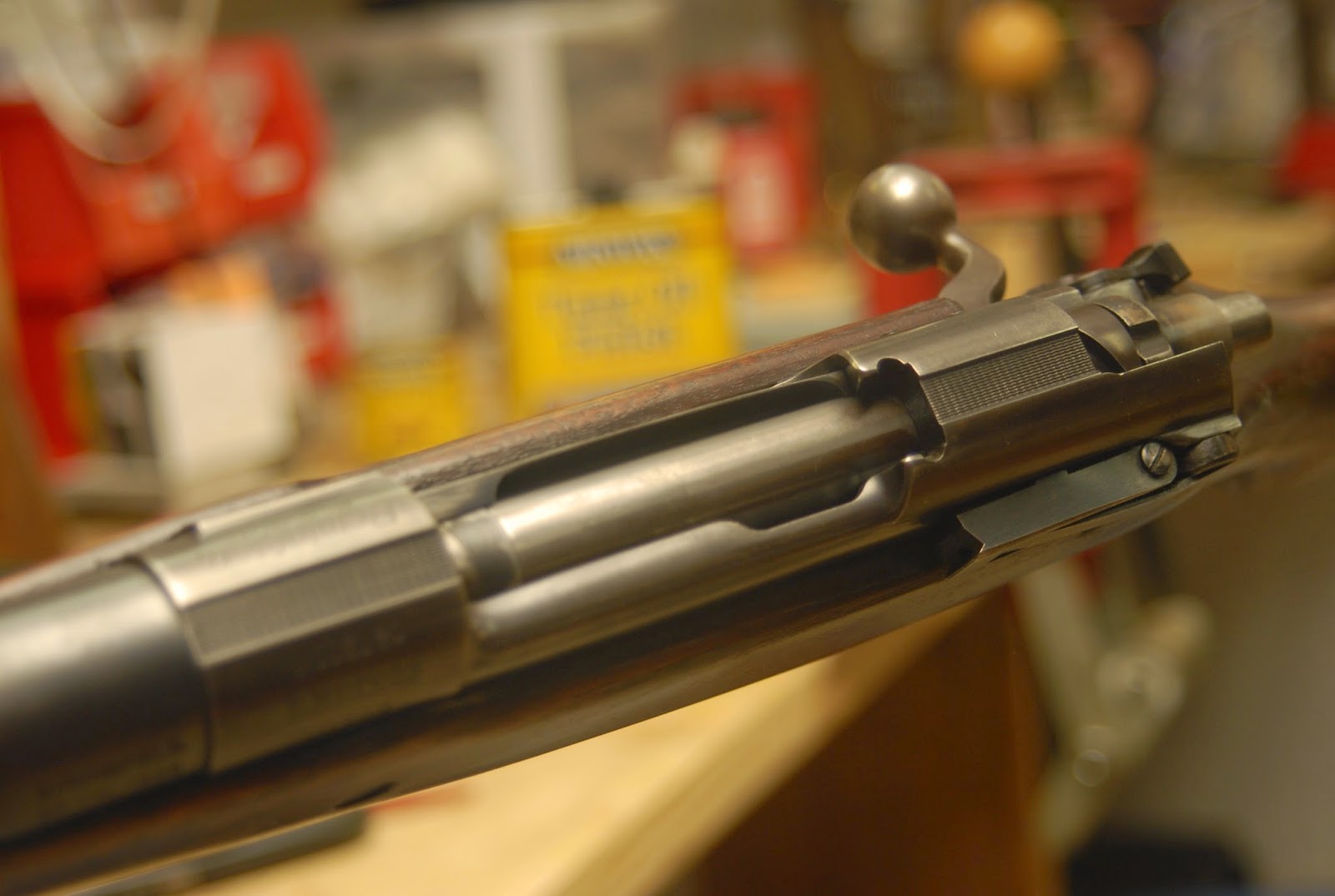
The bolt the safety is attached to is a push-feed type that Winchester utilized to save money after, oh, I don't know, 1964. If you've ever looked at a list of used Winchesters for sale online and read "Pre-64" or "post-64", it is this benchmark, where the company went cheap so they could crank out rifles that cost less to manufacture, that they're talking about. Before, Winchesters had a huge, Mauser-like claw extractor down the length of the bolt. But after 1964, most were made with a round-faced bolt that used a simple little extractor dove-tailed into the edge of the bolt face. Couple that with a spring-loaded plunger for case ejection and you have everything early rifle lovers hated back in 1965 when this "new" model 70 came out. I don't have a problem with this system at all. All Remington's are made practically the same way starting with the Model 721 introduced in 1948.


The cartridge, the 6.5X55mm, is a pussycat and a joy to shoot. Flat shooting and accurate, this cartridge was adopted by the Swedes in 1894! Smokeless powder had only been around for ten years or so, and it just goes to show you, when you start with a winner, you don't need to come up with another. It served them well until the fifties or so. The cartridge is a little short for my Model 70's "long action" and it doesn't quite fill up Winchester's magazine so care must be taken when loading the rifle that ensure the cartridges are pushed all the way to the back. Do this, and you'll have no trouble at all. The bolt face needed a little opening up since the case head on the Swedish cartridge is bigger than our American standard of .473" going all the way up to .480" but that's the only alteration made to the rifle's action.


They really need an intermediate length action, but they'll hunt in a converted
long action. Trust me.

The barrel I ordered is stainless even though the rifle is just blued steel. I say blued, but it looks like some kind of painted-on, baked-on finish. I don't think it's good old-fashioned bluing, and it looks kind of mixed-matched with the stainless steel, silver barrel, but I don't mind that. The fact is, finding a gunsmith that'll blue a gun inside a year from the time he takes it in is like finding unicorn tears. I ordered stainless so I'd get my rifle back before I died of old age. It's not the first rifle I've done like that and it won't be the last. Gunsmiths are on their own time. Even without bluing, be prepared to wait and wait when you're doing a rebarreling job. He or she will get it done, and you might even be pleasantly surprised.

In fact, at the time, my gunsmith buddy did the whole job and handed me the rifle on my birthday and didn't charge me a dime. By job I mean, he unscrewed and discarded the old barrel, threaded and chambered the new barrel, screwed it onto the Model 70 action, checked the headspace, test-fired it and handed it to me, for free. Happy birthday to me. Part of the reason he did so, I think, was that he had had it for so long, and he had accidentally put a long spiral down the base of the barrel with the lathe. So maybe rather than do it all over again, he just thought, "I won't charge him and happy birfday!"


Look close and you can see the crooked cartridge stamp and a nifty spiral.

I left the plastic, oops, I mean polymer, stock it came with on the rifle. I did sand the seam where the two mold halves were joined and my gunsmith did "bed" the rifle with epoxy. That is, where the metal meets the stock, he filled in any and all gaps with an epoxy so there can be no slippage. This is often done to enhance accuracy as it seems to "weld" the action to the stock with absolutely no room for anything to move and thus degrade accuracy. It just works. But if I ever come across a walnut Winchester stock with a blind magazine bottom, I'll probably snag it for the rifle just for the aesthetics, even if this Winchester is set up for real hunting in real messy conditions now. The plastic stock stands up to abuse and wet weather more than fine pieces of walnut do. Couple that with the stainless barrel, and you don't have to nervously sweat if the weather suddenly changes on you while you're hunting.


Plastic stock and stainless barrel make this rifle ready to hunt in any weather.


I have hunted with the rifle a few times and enjoyed each of those with it, but the one I remember most was the hay field. This is the field where the deer would come out of the woodwork at exactly 25 minutes after sunset--last shooting time is 30! And I mean, if they knew you were on the edge, they'd be 300 yards away on the opposite side. And if you switched sides? They would too. I don't know how they'd know, but the deer, mostly big, juicy does just did. I reckon they'd figured out that 300 yards away, at 25 minutes after sunset was just about right to stay safe.

Well, one fall I decided I go prone in the poncho a hundred yards into the field to throw them off. And frankly, it worked. The sun went down and 25 minutes later some deer stepped out of the back corner. In fact, at the time, there were so many of them I just picked one that seemed kind of frisky and shot her. This was at a time when I had really started to get the hunting bug and was learning the game, and it was this doe that taught me a few things.

One: If you're laying down in a field in the late fall and the sun goes down, and you have your Butler Creek scope covers flipped open, your scope just might fog up as the low air around you condenses into dew.

Two: Your eyes can fool you into thinking you're shooting at a big doe a hundred yards away when you're really shooting at a micro-deer that's only forty yards away. In twilight you can really fool yourself, and it just takes more time in the field to learn how to figure this stuff out.

Three: Micro-deer, that is, fawns, are delicious. Easy to kill, carry, butcher, store, cook, and chew. In fact, I always try to harvest a small doe every year if I can. So much better in the pot than a rangy, leathery old buck. 

Oh, the Winchester did its job. A quick wipe of the scope's objective lens with a gloved finger and putting the cross hairs low on her shoulder was all it took to shoot her cleanly. She ran in a tight circle before falling in the hay field and dying quickly. I think one or two people made fun of me for shooting a small doe, but I didn't care. I had just collected a deer in a modern rifle that shot a cartridge that was developed 121 years ago with brass that had been collecting dust in my garage for 9 years! It was a good evening for the Winchester and I.

You can find modern bolt action rifles chambered in the cartridge on the used market for sure. Everyone of the big three have made them at some point, though none do now. Even Winchester made them at some point. And if you do get one, you owe it to yourself to reload for it. Factory ammo is readily available at the big hunting stores but will be loaded for 100 year old 1896 Swedish Mausers that were not made to withstand pressures to which we can reload ammunition. In deference to the older rifles, factory ammunition is kept to pressures well suited for older rifles, but a reloader like me, who shoots a modern, post-64 Winchester Model 70, can squeeze a little more performance out of the Swede knowing the newer action can take it.


The 6.5X55mm Cartridge was designed for this rifle, A Swedish Mauser,
Model of 1896. Factory loads are made safe enough to shoot in these older rifles.

Heck, even if you don't reload and just shoot 140 grain, Core-Lokt ammunition you'll never miss the extra 100 feet per second and the deer will never know the difference. I'd stay away from old military ammo for your modern rifle, but if you're just plinking with an old 96 Mauser I'd say, enjoy. I'm snobby enough to say that my Model 70's barrel has never been polluted with old, military surplus ammo. There's always a small chance when shooting surplus ammunition that they were loaded with "corrosive" primers, so there's not gonna be much chance that I'll shoot them unless there's a horde at the door.

My Model 70, even though it started out life as a "cookie cutter" model, has now become a distinctive rifle that shoots a well-rounded cartridge and shoots it well. I like it not because it's a gorgeous, custom rifle, but because it reminds me of the crooked road, and the slowly-working buddy, that got to me to it. And it's always fun to work up a load for a rifle you had made up from scratch and get it to shoot well enough to carry afield. That might be the most fun of all--imprinting a rifle with ghosts and memories of my own.


If you look up and see this, you might be a deer.


Sunday, May 10, 2015

A Gun a Week: Remington Model 30 Express, Caliber 30, Model 1906.

Remington Model 30 Express, 30 Caliber, 1906.

I've had a thing for Remingtons since the first Model 700 I bought way back in the late '90s. And once you've bought a 700, the acme of Remington rifle evolution, the only way to go is backwards in time. This Model 30 just so happens to be the oldest rifle, oldest Remington, that I own. It's safe to say they don't make them like this anymore, and of course, my gunsmith buddy always says, "Yeah, there's a reason for that!"

The Model 30's story goes all the way back to the Great War, back when England paid Remington to crank out their ugly Enfield P 14 for their war effort. And after the US entered the war, Remington factories were called upon to crank out our version of the P 14 affectionately called the M 17 Enfield. His Majesty's rifles were in .303 British, but our rifles were chambered in a fairly new (at the time) number called Calibre .30, model of 1906. Nowadays we just call it 30-06.

Here's the British version, The Enfield P 14 in .303 British.
When the war was over, Remington was left with three or four factories and thousands of complete and nearly complete rifles that no one needed anymore. Most of those factories were shut down, and left holding the bag, Remington wisely entered the post-war sporter rifle market with a stream-lined version of the battle rifle they called the Model 30. The line of rifles was introduced in 1921, and mine was made in 1926.


And here's the US Army's Enfield M17. They were easier to make than our
premier battle rifle, the Springfield Model 1903.

It's marked MODEL 30 Express on the receiver and the barrel is stamped SPRINGFIELD 30 CAL. 1906. The battle tested cartridge had just started its march to the top of the list for American hunters and shooters. Veteran's back from the war might have been eager to hunt with a the rifle and cartridge with which they were familiar. To this day, 30-06 is the go-to, do-all cartridge that will take any game animal in North America. Most of America's military cartridges are still quite popular today going back to the 45-70 Government. The only one that isn't as popular as the others is the 30-40 Krag, or 30 Army. Never heard of it? Yeah, neither has anyone else. But the 30-06 is here to stay.


Nicely tapered tapered barrel for sporting purposes.

Remington did all they could to sporterize the M17 and make one of the ugliest military rifles better suited and better looking for the field. They chopped off the gigantic rear sight housing on the receiver bridge and dove-tailed the new rear sight onto the now nicely tapered sporter weight barrel. What they couldn't get rid of was the less-than-sleek safety lever that is as big as I have ever seen on a rifle. To say it's obtrusive is an understatement! It's as big as a human thumb and swings to and fro just over ninety degrees. The only positive thing I can say about it is that it's a positive safety. You flip this monster all the way over and you're positive the safety is engaged. It is right by your thumb though, and I guess that's nice.


Now that is a safety lever! Note the two filler screws for an after market receiver sight. 

The Model 30 is a shameless Mauser rip-off just like its Model 1903 cousin (but that's another post). There's no denying it. The ugly, dog-legged bolt sports the massive claw extractor and two locking lugs the Mauser brothers made famous. And on the left side of the receiver there's a huge, Mauser-like bolt release that you yank to remove the bolt for cleaning and maintenance. The Model 30 even retained the stripper clip guide that was milled into the receiver of the Enfields, and I suppose some hunters would have used it, especially if they had been trained for battle with the rifle. Stripper clips can still be found at gun shows and mail order, and it might be fun to use them hunting--better than having your cartridges clinking around in your pocket.


Massive extractor claw, stripper clip guide, and huge bolt release all inherited from
the Mauser K98.

The stock is a slender rail of walnut with a schnabel forearm and finger grooves. To me, its straight-combed stock feels a tad high for its open sights, as if they anticipated folks scoping the rifles even though the receiver isn't drilled and tapped for scope mounts. You really have to jam your cheek onto the stock to get them lined up the way I was taught to shoot open sights. The receiver is drilled and tapped for a receiver sight like a Williams or a Lyman on the right side, which might be easier to utilize with this stock. I could get a higher front sight I guess, but so far it's done its job when asked.

Like a bunch of rifles from the early years of the 20th century, this rifle has a steel butt plate. And if it were a stone-cold shooter, I'd probably replace the torture device with a rubber recoil pad. But since it has some collector value--even if just to me--I'm content to keep it as is. Shooting from the bench isn't any fun, that's for sure. But when you're hunting, you never feel the recoil, and that's a fact. When I'm hunting, I'm usually bundled up in winter clothes, and when I'm shooting from the bench, I have an old knee pad that goes under my shirt so the other shooters can't see it and make fun of me.


A steel butt plate and a lightweight walnut stock equals quite a thump when shooting.

Before I took this rifle hunting, I did shoot it from the bench. A pretty unscientific undertaking, but since I would just be shooting for the deer's vitals and not bench-rest accuracy, I set a 5 1/2" X 8 1/2" red card at the hundred yard target stand and let fly some home-manufactured 30-06 cartridges. If I can get the bullets into that size rectangle at 100 yards, then I'm pretty certain I can hit a deer in the vitals at the same range and closer. I know that any further out than 100 yards I'll have trouble even seeing the deer as they tend to disappear behind the rifle's front sight. And if's it's predawn or post sunset, I can forget about it. So 100 yards has always been my default limit for open sight hunting, and additionally, I only do so during the morning hunts because as the morning moves along, the sunlight gets brighter and brighter increasing my ability and confidence.

The first time I hunted with it was a grey, drizzle-filled New Year's Day morning--the last day of the season. Earlier that morning while sitting in the stand I was busted by a little spike buck that had walked out of the pines underneath me and he made such a big deal out of seeing me that I thought I wouldn't see another deer the rest of the morning. But soon enough, across the gas line clearing from me, a doe stepped out quietly from the thicket and stared right down the gas line at my friend who was up a tree further down. While she studied him, she stood in a classic broadside right in front of me about 68 yards away. A quick neck shot and she was mine instantly. No tracking was necessary.


It's quite a good feeling taking a rifle that you know was made for war, retooled for hunting, and then probably forgotten for decades out into the field to hunt and harvest a deer. For me, who believes that objects have ghosts with them, it's putting these haints to rest when I use the object, the rifle, for the purpose it was intended that I like. When you shoulder an old rifle and when you shoot it, you're repeating a process that some nameless ghosts did before you. You feel the same heft. You feel the same recoil. You hear the same report just as those ghosts did years before you, and that's a really familiar feeling among hunters.